Przewalski’s Horse
I.U.C.N status
International Union for Conservation of Nature


Identity card
Grass, plants, fruits, bark, buds...
Did you know?
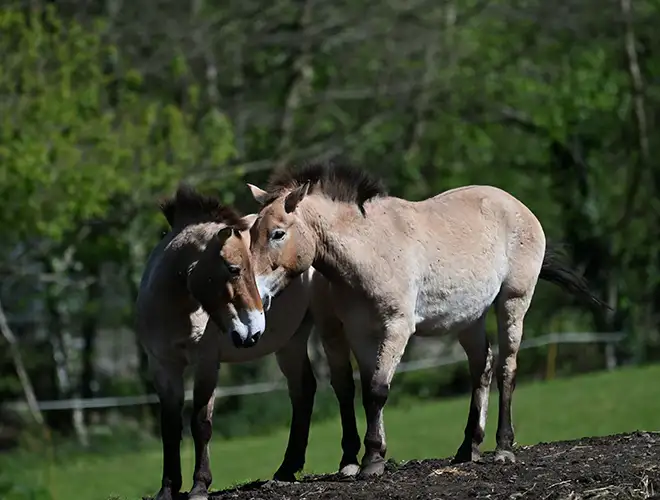
The Przewalski’s horse lives in small family groups, made up of a stallion, a few mares and their young. This sturdy equid is the direct descendant of the horses that adorned the walls of prehistoric caves in Europe, between 30,000 and 9,000 years before our era. Despite their genetic closeness to domestic horses, to which they are linked by a common ancestor, Przewalski’s horses retain a unique distinction: they have 66 chromosomes, compared to 64 for their domesticated cousins.
Threats and conservation
Discovered in 1879 by Russian explorer Nikolai Przewalski, the Przewalski’s horse had disappeared from the wild by the late 1960s due to hunting, capture and competition with domestic species. Individuals captured in the early 20th century made it possible to create international breeding programmes. Today, more than 1,500 horses live in zoological parks and reserves, and since the 1990s, reintroductions in Mongolia have allowed more than 300 horses to return to the steppes.